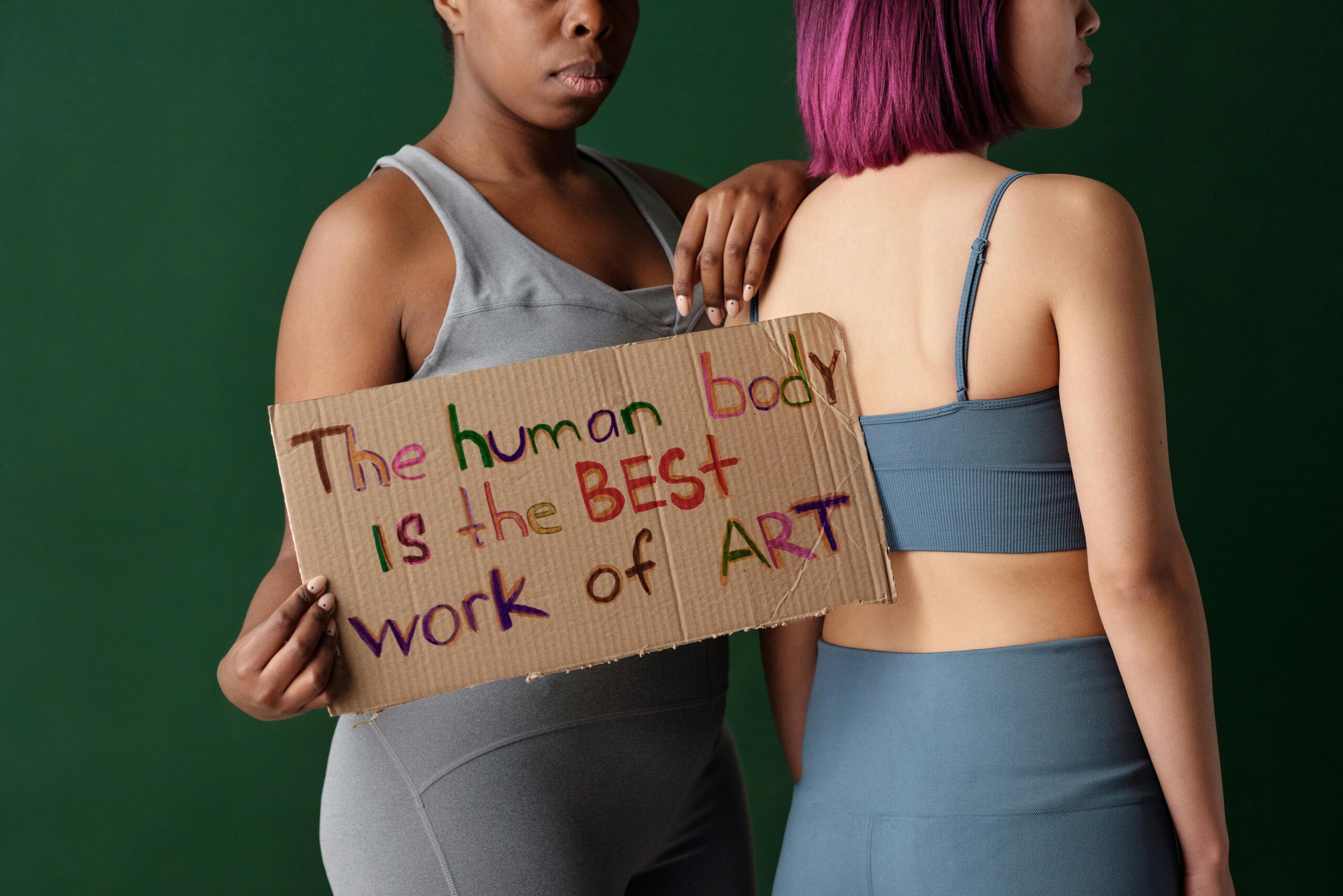
The Body Society Builds: How Women Are Taught to See Themselves
Remember the last time when you felt unconditionally fine with your body? For many women, that moment is hard to remember. We adjust, compare, critique. We notice what is too much or not enough. We reach for the word fine and find something more complicated underneath it.
That discomfort has a long history and none of it is your fault.
For as long as history has been recorded, women’s bodies have been judged, admired, controlled, and redefined. The idea of the “perfect” female body has never stayed the same for long, because it has always been shaped by the values of society rather than by any universal truth. As feminist scholar Susan Bordo puts it in her landmark work Unbearable Weight, the female body is not a neutral biological fact but “a text shaped by Western philosophy and cultural perceptions of femininity”, a surface on which the anxieties, desires, and power structures of each era are inscribed (Bordo, 1993).
What follows is an attempt to trace that history through sociology, feminist psychology, sport science, and digital culture research. And to show how the self-consciousness so many women carry is not a private failing. It is a social product, carefully built and continuously maintained.
The Body Is Never Just a Body
Sociologist Alexandra Howson opens her textbook The Body in Society with a provocation: the body you live in is not simply a biological object. It is continuously made and remade through cultural norms, institutional power, and social interaction (Howson, 2013). Every era decides what a woman’s body should look like, and those decisions are never neutral. They reflect who holds power and what that power needs the female body to communicate.
This is perhaps most visible in the sweep of history.
In the prehistoric period, the so-called Venus figurines, dating as far back as 35,000 years ago, depict women with exaggerated curves, wide hips, and full breasts, widely interpreted as symbols of fertility, survival, or sacred femininity (Dixson & Dixson, 2011). In medieval Europe, the Church positioned women’s physicality as a potential source of sin; bodily modesty became a marker of spiritual virtue and moral worth. By the 16th century, the corset emerged as a tool for physically reshaping women’s bodies to meet the fashionable ideal first among the nobility, then spreading across social classes (Britannica, 2024). Women of the French court considered the corset “indispensable to the beauty of the female figure,” and by the Victorian era it was mass-produced and widely worn, its hourglass silhouette enforcing both aesthetic conformity and social respectability. Health consequences such as reduced lung capacity, spinal deformity, and digestive damage were well documented and widely ignored (The Museum at FIT, n.d.).
The 20th century accelerated the pace of change. The 1920s flapper demanded a flat chest and boyish silhouette. By the 1950s Marilyn Monroe’s curvaceous hourglass was the Hollywood standard. Then, in the 1960s, model Lesley Lawson known as Twiggy made extreme thinness internationally aspirational at precisely the moment eating disorders began attracting mainstream medical attention (Dietetically Speaking, 2021). Researchers at the University of Wisconsin-Madison have noted that the two periods in which the “ideal woman” was thinnest in American history are in the 1920s and the 1980s. It also corresponded to the highest recorded rates of disordered eating (cited in CNN, 2018). The pattern is not coincidental.
What changes is the specific ideal. What never changes is the demand that women conform to one.
The Weight Standard Is a Woman Standard
Here is what makes the history above more than a curiosity: the same values encoded in each era’s body ideal are encoded in each era’s expectations of womanhood itself. This is the central argument of psychologist Nita Mary McKinley in her chapter “Ideal Weight/Ideal Women: Society Constructs the Female” (McKinley, 1999).
McKinley shows that the qualities attributed to the “ideal body”, like smallness, restraint, control, and unobtrusiveness, are identical to the qualities demanded of the “ideal woman” under patriarchy. Fatness is culturally coded as lazy, undisciplined, sexually threatening, and unfeminine. Thinness is coded as virtuous, controlled, and morally worthy. The body becomes the visible proof of a woman’s character. Weight norms are not health standards, they are gendered moral judgements written on flesh.
What makes McKinley’s work particularly powerful is her account of how this external control becomes internal. She introduces the concept of Objectified Body Consciousness (OBC), the process by which women learn to view their own bodies from an imagined outsider’s perspective, as though permanently under observation (McKinley & Hyde, 1996). OBC operates through three interlocking mechanisms:
- Body surveillance — continuously monitoring your own appearance as though through an observer’s eyes, checking whether it meets external standards.
- Body shame — feeling shame not just about a specific body part but about your whole self when your appearance falls short.
- Appearance control beliefs — the conviction that your body shape is entirely within your control, which quietly transforms structural inequality into personal failure.
The research consequences are stark. McKinley and Hyde (1996) found that body surveillance and body shame correlated negatively with body esteem, and all three OBC dimensions were positively related to disordered eating. Women showed significantly higher surveillance, shame, and actual-to-ideal weight discrepancy than men. When OBC was controlled for in analysis, the gender gap in body esteem disappeared entirely, suggesting it is not being a woman that drives the difference, but the social experience of being treated as a body to be evaluated (McKinley, 1998).
McKinley also makes a point that is easy to miss: fat stigma does not only harm fat women. It disciplines every woman’s relationship with her body, producing what researchers call “normative discontent”. A near-universal, low-grade dissatisfaction so common it passes as a personality trait rather than a social condition (McKinley, 1999). That chronic background noise of not-quite-right is not yours. It was handed to you.
The Gym Is a Panopticon
If OBC describes the psychological interior, sport sociologist Pirkko Markula’s research shows us exactly where it plays out physically: the aerobics class.
In her 1995 paper “Firm but Shapely, Fit but Sexy, Strong but Thin: The Postmodern Aerobicizing Female Bodies,” published in the Sociology of Sport Journal, Markula combined ethnographic fieldwork inside aerobics studios, in-depth interviews with women participants, and critical analysis of fitness media to map what she called “the cultural dialogue surrounding the female body image in aerobics” (Markula, 1995).
What she found at the centre of that dialogue was a structure of built-in contradiction. The fitness ideal demanded that women be simultaneously firm and shapely, fit and sexy, strong and thin. The three pairs of qualities that pull against each other by design (Markula, 1995). You cannot maximise both strength and thinness. You cannot be both athletically fit and conventionally soft. The ideal is internally incoherent, and that incoherence is commercially useful: a goal you can never fully reach keeps you enrolled, purchasing, and returning.
Drawing on Foucault’s concept of the panopticon, the prison structure in which inmates can never be sure when they are being watched, and therefore police themselves at all times. Markula argues that the aerobics studio functions as a disciplinary space (Markula, 1995). Mirrored walls. The instructor’s body as a standard. The presence of other women, all watching and being watched. Together these create a structure of permanent, internalised surveillance. Women do not simply exercise; they watch themselves exercising, evaluating their performance against an ideal as though through the eyes of an observer who is always present. They become their own jailers.
Markula’s interviews revealed something that cuts even deeper. The women she spoke with were not naive. They could articulate the contradiction. They described their pursuit of the ideal as, in their own words, “ridiculous” and then went back to class (Markula, 1995). This is the particular sophistication of the power being described: it maintains compliance by absorbing the critique. Knowing the game is rigged does not automatically let you stop playing.
But Markula does not end here. She insists on feminist agency. Women who recognise the absurdity are already practising a form of resistance. The task is to move from individual awareness to something collective: to reclaim exercise as a practice oriented toward what your body can do and how it feels, rather than how it appears to others (Markula, 1995).
Social Media Is the Same Story at Scale
The dynamics that Howson, McKinley, and Markula identified decades ago have not been softened in the digital age. They have been amplified, accelerated, and personalised.
Social media has transformed women from consumers of idealised body images into active producers and curators of their own. The pressure to present a managed, aspirational version of oneself generates a continuous loop of comparison, evaluation, and self-monitoring. Every scroll is a potential moment of surveillance, every image is a potential reminder of falling short.
The research is consistent. A meta-analysis by de Valle et al. (2021), drawing on experimental and longitudinal evidence, confirmed that social media use is causally linked to body image disturbance in women. A study by Jiotsa et al. (2021), conducted with 1,331 participants aged 15 to 35, found a significant association between how often people compare their appearance to those they follow online and levels of body dissatisfaction and drive for thinness. A controlled experiment by Castellanos Silva and Steins (2023) found that just three minutes of exposure to Instagram images reflecting hegemonic beauty ideals produced measurable increases in body dissatisfaction while three minutes of body-diverse content reduced it.
Three minutes.
The mechanism is the same one McKinley named in the 1990s that body surveillance, shame, and the belief that the gap between you and the ideal is simply a matter of trying harder. Social media did not invent this. It scaled it.
What This All Means
Howson’s sociology, McKinley’s feminist psychology, Markula’s sport science, and contemporary digital research are telling the same story from different angles.
The female body has always been a site where social power is exercised. The specific ideal changes full in one era, thin in another, toned and thin simultaneously in another but the underlying structure does not. Women are evaluated against a standard they did not set, socially penalised for failing to meet it, and sold products that promise to close the gap. The chronic background sense that your body is not quite right is not a personality trait or a failure of self-love. It is the predictable output of a system that requires women to feel that way in order to function.
Recognising this does not automatically fix anything. As both McKinley (1999) and Markula (1995) are careful to note, individual awareness, while necessary, is not sufficient. The structures that produce the ideal, patriarchy, consumer capitalism, a media culture built on manufactured inadequacy, do not dissolve when you name them. But naming them is still the beginning. It is the difference between carrying the weight as though it is yours and understanding where it actually came from.
Body ideals are socially created, not natural laws. What one era praises, another may reject. That is not relativism, it is an invitation. If the ideal is built, it can be questioned. If it is maintained, it can be challenged. And if women have always found ways to laugh at the absurdity of what is demanded of them, as Markula’s interviewees did, then there has always been, alongside the compliance, a thread of resistance worth following.
Ultimately, the most important lesson from these perspectives is that our bodies are never simply personal projects. The way we eat, move, age, dress, evaluate ourselves, and judge others is shaped by powerful social expectations that often operate unnoticed. Recognising these influences does not mean abandoning responsibility for our wellbeing; rather, it means understanding that health, fitness, and body image are not determined by willpower alone.
In practice, this means questioning body ideals presented by media and consumer culture, resisting the urge to measure worth through appearance, and paying attention to how social norms influence everyday choices. It means approaching physical activity as a source of strength, health, enjoyment, and connection rather than a tool for achieving an idealised body. It also means challenging stigma wherever it appears, whether directed at larger bodies, ageing bodies, disabled bodies, or any body that falls outside socially constructed standards of “normal.”
Most importantly, these theories encourage us to replace judgement with critical awareness. Instead of asking whether bodies conform to cultural expectations, we can ask who created those expectations, whose interests they serve, and who is excluded by them. By viewing the body through a sociological lens, we can begin to recognise that many of our deepest assumptions about health, appearance, fitness, and worth are not natural truths but social constructions. This awareness gives us the opportunity to make more informed choices, challenge harmful norms, and create spaces where all bodies are valued with dignity and respect.